How do you teach someone to think in complex systems or imagine a world beyond the present society? A German pilot game drawing on Earth4All shows that games can be a powerful tool for building transformation literacy.
Teaching system change is hard
Humans create their vision of the world as a coherent story. We are so good at this that we often forget that our worldview is a construct, not an unchangeable reality. Our collective inability to imagine an alternative to today’s economic system is the clearest example: Believing that an economy built for wellbeing and a stable planet is even possible means questioning how society works and our own role in it. That is uncomfortable.
Change also feels risky, even when the status quo leads straight to catastrophe. So, we’re biased to giving the status quo more credit than it deserves and pick apart every alternative.
Add the short attention span of modern life and teaching system change and system dynamics, like Earth4All aims to do, becomes a real challenge.
Games: A safe space for imagining another world
Games help meet this challenge. They open up a fictional space players can control. Because the setting is fictional, players can test scenarios that go against the status quo without having to suffer the consequences in reality. This creates a space to imagine other versions of the world safely.
Games also turn knowledge into experience. Just as lion cubs will play-fight rather than take on a hippo, people can test what works and what doesn’t through playful repetition, building transformation literacy along the way.
The games’ visual, interactive nature also makes complexity easier to grasp. Players can see how systems interact – like Earth4All’s five turnarounds, without the dynamics disappearing into an oversimplified summary.
The Earth4All simulator game for schools
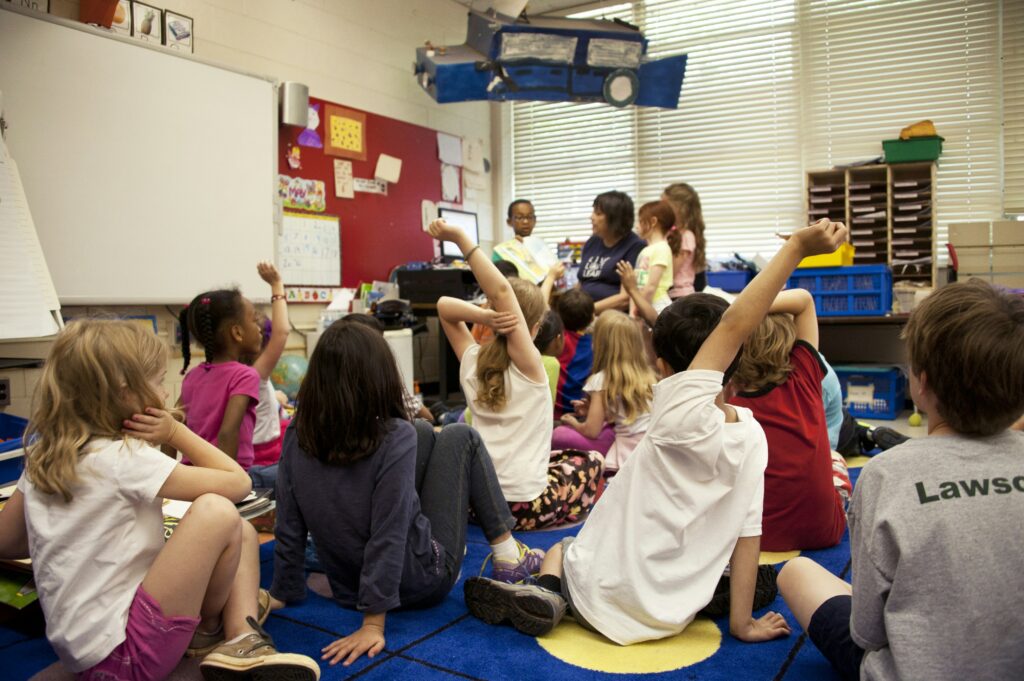
We tested this approach in Germany with the Earth4All Simulator Game »Das Parlament der Zukunft« (Parliament of the Future), designed for school classes aged 16 to 18. It is built on a PC simulator that Ulrich Golüke, part of the Earth4All modelling team, developed from the international Earth4All study. The game draws on Earth4All’s framework, data and models and is free to use.
To ensure that the insights gained in the fiction are connected to reality, the game is framed by two educational sessions:
- Preparation session: introduction of Earth4All, system dynamics and the Wellbeing Index; exercises on feedback loops and rebound effects as well as democratic discussion
- Game session: partly in a web app, with videos, decisions and results; partly as classroom discussion
- Reflection session: what did we learn, how did we feel in our role, what can we do in the real world?
The game setting
In the game, ministers from five regions meet in the “Parliament of the Future.” Their mission reflects Earth4All’s vision of transformation:
- Lift the regional and global wellbeing index “in the green zone”: Wellbeing translates Earth4All’s turnarounds into a simple vision close to the students’ everyday experience – a better life.
- Hold global temperature rise to 1.6 °C: The combination of wellbeing index and temperature shows the link between society and ecology.
Players take on 6 ministries per region (depending on the number of players, regions can also be run by the app on an automatic setting). Each ministry decides over three to four policies. Over three rounds spanning 60 years, the players negotiate and distribute money across their policies. Subsequently, the app simulates the regional and global outcome of these choices over the decades and the players discuss the consequences.
What we learnt
The game is in its final prototyping phase and will launch soon. We have tested it with ten groups (students, young college students and teachers) and the trials gave us valuable insights:
- Learning through simulation feedback works: Students were often surprised and even frustrated by the outcomes of their choices and argued fiercely about how to change them.
- Students brought ethics into the debate: Once trade-offs became visible, they demanded discussions about global justice, even where the game itself did not raise the issue.
- The teachers are the multiplier: A well-prepared teacher can extend the workshop into two or three follow-up lessons and bring the Earth4All content to life, but we cannot assume every teacher has the time to do this alone.
Most importantly, students got the point and applied it. One 11th-grader from Munich put it simply: “I never realized that social tensions and climate are interconnected.” Many left with real ideas for turning what they learned into action.
Our experience showed us that Serious Games are a useful vehicle for communicating transformation: Fiction gives players a safe space to imagine societal change; the educational sessions around it turn that experience into real-world impact.
Want to learn more, use the game with a German-speaking audience, or translate it into another language? Get in touch: kohlrausch@oekom.de
Developing the game was only possible thanks to our amazing contributors: The whole Earth4All team for the framework; Ulrich Golüke for the original game design; Nathalie Spittler for test runs and feedback on the original game design; Martin Hoffman and the Ludwig-Maximilians-University Munich for scientific and pedagogic support; Off the Beaten Track for the programming and design; Landeshauptstadt München, BarmeniaGothaer Stiftung and Deutsche Klimastiftung for their financial support.