In May, Earth4All sponsored a remarkable concert, Jiwa Kala (Soul of the Times), in a decommissioned nuclear reactor deep beneath Stockholm. Jiwa Kala was performed by Peni Candra Rini, one of the world’s most remarkable contemporary composers and singers. Her works explore humanity’s relationship to ecosystems and how, in the Anthropocene, this connection has become toxic and obscene. Before her performance, she told the story of her unique childhood to Francesca Larosa, which I will relate here.
————————————
“I grew up in East Java. We were all so very, very poor. My father was a fisherman. He used to have to walk four to five hours to the shore through the forest. He would take me when I was very young. But I was scared walking through the thick forest.
— Let’s start to sing.
— I don’t want to sing, I feel scared.
He always combined singing with nature’s sounds…animals, oceans, wave sounds.
He taught me songs about food, this and that bird sound.
— Listen to the wind! When we arrive at the ocean, you must sing to the waves.
I was like: this is too much, father. I have already sung a lot on the way, why sing in front of the wave with no people here who will listen to me?
My father answered.
—The future will listen to you.
And I think now is the future. And you will listen…later.”
————————————
Peni Candra Rini was the first woman to receive a doctorate for Karawitan, the theory and practice of gamelan and its connected intricate vocal tradition. She explains that she expresses nature while she sings and performs.
Her new work, premiered in the United States in April, is a performance about balance.
————————————
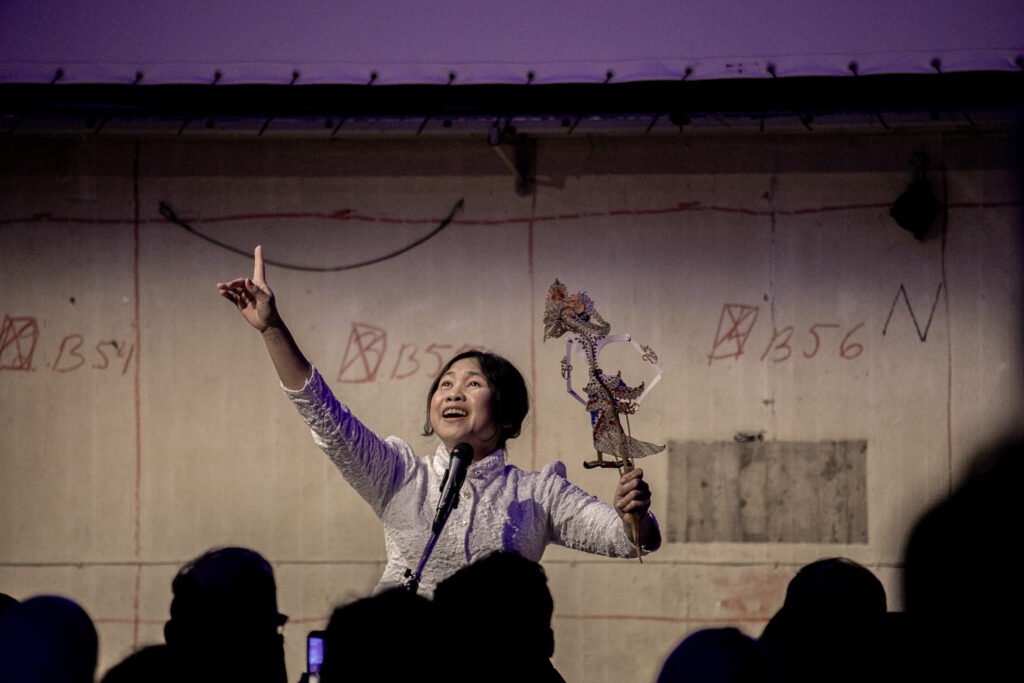
“Jiwa means “soul”. Kala means “time.” Soul of the Times. This piece is about natural balance. About ecological issues in Indonesia. I am really pained for these times today.
When I feel drought.
When I feel rain—the rain now is really crazy.
When forests are burnt.
I feel this pain.
The forest where I am from have now been replaced with mono…mono…these palm plantations…monoculture.
This is not the wild forests from my childhood.
I remember how my father always brought offerings in every step of our life: fruit, rice, vegetables, mantras, chanting belief in the goddesses.
In Java, Bali, Indonesia we have goddesses who protect our land. The goddess of fertility Dewi Sri, goddess of the ocean Kanjeng Ratu Kidul. We have Durga, goddess of anger and Saraswati goddess of knowledge. And goddess of Earth: Pertiwi. So in our culture, balance in life is: “mother”.
We give these goddesses offerings. We must present to our goddesses our mothers the best fruit, the best rice, the best water, pure spring water. That means if we keep all our fruit and water clean that means we keep our Earth wonderfully. But if we destroy and forget all the offerings…my performance is about how we keep this balance.”
————————————
Peni Candra Rini’s stories are both exotic to my Western ears, but also familiar. East Javan traditions are hardly unique. In many, perhaps all cultures, rituals connect us to nature, to fertile soils, to rain. We pray for good harvests. We once thanked the forest when we cut a tree. We acknowledged ecosystems, the biosphere, daily for providing for us. We thanked the biosphere for balance and harmony. We made a promise to the biosphere to preserve that harmony.
Perhaps the Abrahamic religions simply replaced the word “biosphere” with the word “God”. But of course that has all gone up in smoke now. We’ve burnt that contract with nature. Bit by bit. And now we see the consequences: the Great Acceleration. The Great Destabilisation. We have now, at the latest count, exceeded seven of nine planetary boundaries. The goddess of anger has every right to erupt…and is clearly very angry as we step closer to a super-powered El Niño this year. Beyond El Niño, we are seeing signs of deep destabilisation of our life support system: the Greenland ice sheet. The West Antarctic ice sheet. The Amazon rainforest. Tropical coral reefs. The Atlantic meridional overturning circulation.
It seems reconnecting with our biosphere starts with reconnecting with our past, our cultural heritage. The origin of our cultures are the ecosystems from where they were born, whether it is Peni’s forests and ocean of East Java, or my own culture from Ireland, Britain and now Sweden.
In 2023, two men in northern Britain cut down a famous sycamore tree — the Sycamore Gap tree — for no reason but to offend. And offend it did. The public outcry across the UK was enormous. It would have been hard to find anyone not offended by it. The media covered the mystery for days. It was a mystery. Why would someone do this wanton act of destruction? Most people had never seen the tree in real life but it had become a cultural icon, there in a dip in the ground by Hadrian’s Wall.
Living in a forest east of Stockholm, I once watched in shock as a small area was cleared by heavy machinery. A single man operating a gigantic insectoid machine like Edward Scissorshands would grab a trunk, whizz the blade through the base, flip it on its side, claw through to the tip stripping every branch, slicing even logs and dumping in the wagon — all in less than sixty seconds. Then on to the next. In an hour, all that was left was a stumped wasteland. An entire ecology destroyed. I was not prepared for the scale and brutality. We in the west are often insulated from the shock of the Great Acceleration.
————————————
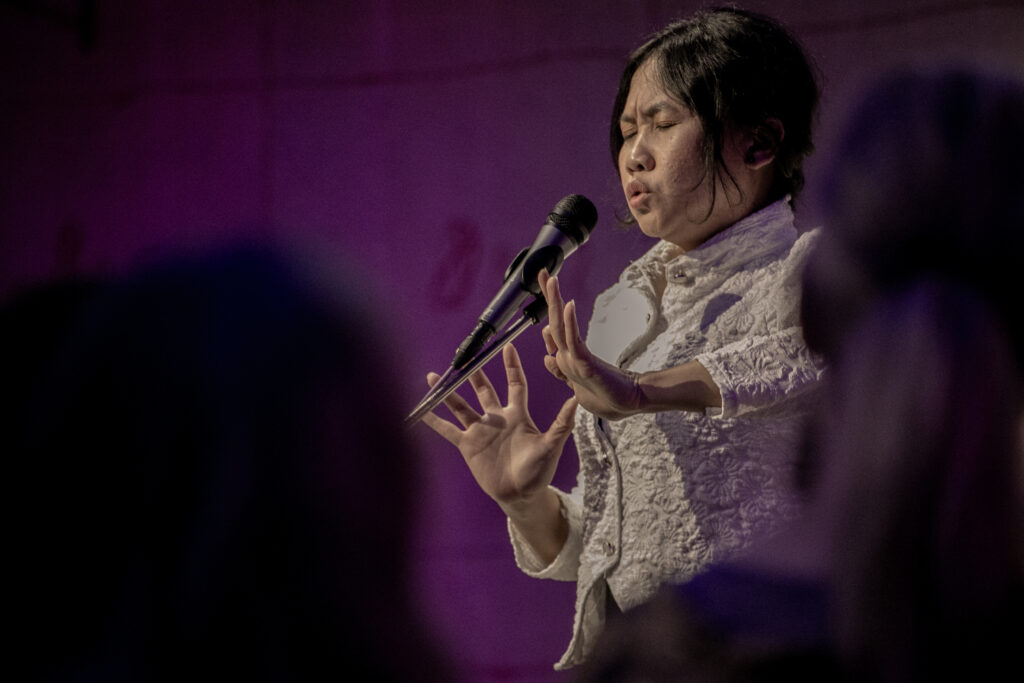
Peni’s performance is haunting and beautiful. Her voice soars through octaves. David Harrington from the Kronos Quartet has described Peni as one of the world’s best singers. Throughout the 60 minutes, the music and narrative move from hypnotic and meditative to primal, disturbing screams. The story takes place within rhythms and microtonal melodies that come from far beyond the western tradition of music. On the screen, animated frogs gasp for air as waves of plastic bottles and other trash flow downstream. A discombobulating feeling deep in this decommissioned nuclear reactor.
In 2025, I set up a record label with Per Olsson, deputy science director of the Stockholm Resilience Centre: Strange Attractors Records*. We want to develop projects between artists like Peni and researchers to explore deep emotional connections to the biosphere and to each other. We created a manifesto for the label: to release 50 songs for love of the biosphere. We have released three to date.
Peni’s concert was part of this collaboration. The event has already started a discussion to bring Peni back to Stockholm for a performance linked to Stockholm Water Week in 2027. As Earth4All develops into its next phase, I would love to see our community develop deeper collaborations with artists and writers. There are two types of truth: scientific truth and emotional truth. I have a feeling that connecting these two truths directs us towards some sort of wisdom.
*Strange Attractors are the equations that describe complex behaviour. The butterfly effect is a strange attractor.