
The Earth for All 2026 Survey
Rebuild trust: rigged economies, fractured societies and the case for change
People across the G20 want their economies transformed. They no longer trust their governments to do it.
What we asked
The Global Commons Survey (2021) and Earth for All Survey (2024) established that most people in most large economies support planetary stewardship and economic system change. Yet action has not followed. This third wave asks why, focusing on social tension and social cohesion.
We measured how citizens see the fairness of their economy, how divided they believe their society has become, how far they trust the state to act for the long term and on what terms they will support large-scale change. The results are compiled in a new report co-authored by Kate Pickett and Owen Gaffney, Rebuild Trust: Rigged economies, fractured societies and the case for change.
What we learned
Societies are remarkably united in their diagnosis of what is wrong with the economy — and no longer trusting anyone to fix it.
- The system is seen as rigged almost everywhere.
70% say there is too much economic inequality. 65% say the system is rigged to benefit the rich and powerful. 69% want major changes to the economic system, against just 8% who disagree. - Societies feel themselves coming apart.
Two-thirds (67%) say their country is more divided than a decade ago, citing serious tension between political parties (71%), income groups (63%), immigrants and the native-born (62%) and the climate-concerned and the sceptical (53%) - Trust in government to act for the long term has collapsed.
Only 31% believe their government will make decisions that benefit the majority of people twenty or thirty years from now.
Click the arrows to explore the data
Where a public wants radical change and mainstream politics does not offer it, that space is filled by whoever promises change first, with or without democratic safeguards. The alternative is a new social contract that takes the scale of change people are asking for seriously.
Methodology
The survey was conducted by Ipsos across G20 countries plus Sweden. China and Saudi Arabia were excluded owing to sensitivities around questions of a political nature; Russia was excluded because of the war in Ukraine. The 17 countries surveyed together account for 58% of global GDP, 38% of the world’s population and 37% of global CO₂ emissions from fossil fuels and industry.
Uncovering global attitudes to systems change
Since 2021, Earth4All and partners have worked with Ipsos UK to survey global attitudes to some of the most pressing issues of our time, from the economy to the state of nature and trust in government.
The programme now runs to three waves: the Global Commons Survey in 2021, the Earth for All Survey and Global Commons Survey in 2024 and this third wave in 2026.
Political debate frequently treats ambitious economic and environmental action as something the public will not tolerate. Across three surveys, we have found the opposite. Understanding what people actually want — and what stands in the way of them getting it — is the starting point for change.

Earth for All and Global Commons Surveys 2024
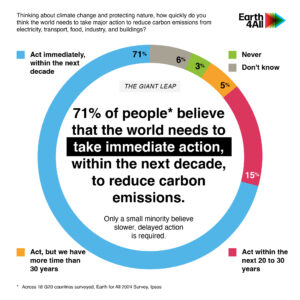
In 2024, we released two waves of survey data in partnership with the Global Commons Alliance: the Earth for All Survey, focusing on economic systems change, and the Global Commons Survey, unpacking attitudes to planetary stewardship.
Global Commons Survey 2021
Look back at data from the very first Global Commons Survey, commissioned by the Global Commons Alliance with support
from Earth4All and FAIRTRANS in 2021.

FAQ
What is the Earth for All Survey 2026?
Which countries were included in the Earth for All Survey 2026?
What are the main findings of the Earth for All Survey 2026?
Do most people think the economic system is rigged in favour of the rich?
How many people worry about affording their basic needs in 2026?
Which countries are most willing to pay more to support climate action?
Which countries have least trust in their government to make long-term decisions that benefit the majority?
Which countries most trust their government to make long-term decisions that benefit the majority?
Why is trust in government lowest in wealthy, established democracies?
Do people think their country is more divided than it was 10 years ago?
What divides people most within their own society in 2026?
Do people feel they're treated with respect and dignity?
Do people still support democracy in 2026?
How many people would prefer a strong leader over parliament and elections?
Do people want major changes to their economic system?
How does trust in government in 2026 compare with 2024?
Who conducted the Earth for All Survey 2026, and who published it?
Stay up to date with new insights
To receive updates from Earth4All, including new data and insights from our global survey, sign up for our newsletter.